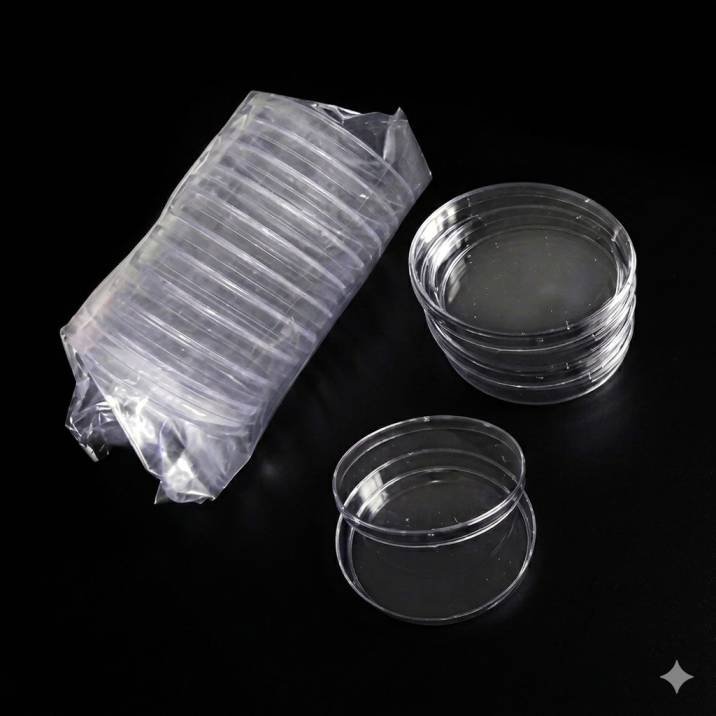
Description
Product Specifications
| Specification | Details |
|---|---|
| Product Name | Plastic Petri Dish |
| Material | Transparent Plastic |
| Type | Disposable Petri Plate |
| Sterility | Sterile / Non-Sterile Options |
| Shape | Round |
| Usage | Laboratory & Microbiology |
| Feature | Lid Included |
| Reusability | Single Use |
| Application | Scientific & Laboratory Use |
Available Sizes
- 35 mm
- 60 mm
- 90 mm
- 100 mm
- 120 mm
- 150 mm
Used For:
- Microbiology culture testing
- Bacterial culture growth
- Fungal culture observation
- Laboratory sample testing
- Cell culture applications
- Scientific experiments
- Educational laboratory practicals
- Food microbiology testing
- Pharmaceutical laboratory analysis
- Research laboratory studies
Benefits of Using Plastic Petri Dishes
- Provides contamination-controlled environment
- Excellent visibility for sample observation
- Lightweight and easy handling
- Disposable for improved hygiene
- Suitable for routine laboratory testing
- Easy stacking and storage
- Reduces cross-contamination risks
Why Choose This Plastic Petri Dish?
This plastic petri dish offers excellent transparency, contamination protection, and laboratory-grade quality for reliable microbiology and scientific applications. Its disposable design improves hygiene and laboratory efficiency.
FAQ
Why are petri dishes important in microbiology?
Petri dishes provide a controlled environment for growing and studying microorganisms in laboratory conditions.
What is the difference between glass and plastic petri dishes?
Plastic petri dishes are lightweight and disposable, while glass petri dishes are reusable after sterilization.
Can petri dishes be used for fungal cultures?
Yes, petri dishes are commonly used for fungal and bacterial culture studies.
How should petri dishes be stored?
Petri dishes should be stored in a clean, dry environment away from contamination and direct sunlight.
Reviews
There are no reviews yet.