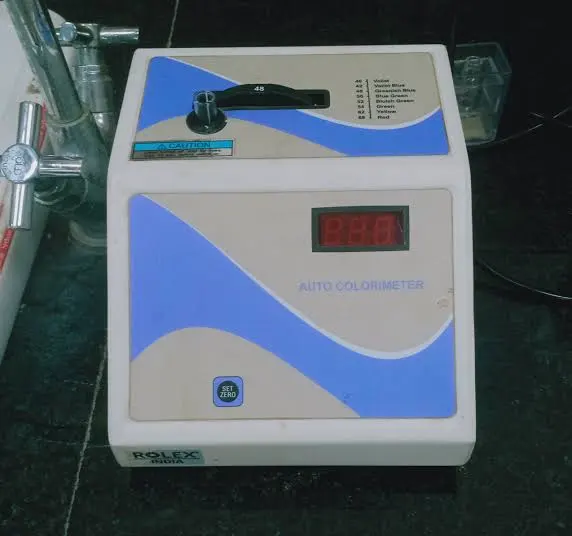
Description
Applications and Usage
The colorimeter is widely used across various industries and laboratory environments.
Water Testing Laboratories
Used for measuring chlorine, phosphate, nitrate, iron, and other water quality parameters.
Educational and Academic Laboratories
Suitable for chemistry, biology, and environmental science practical experiments.
Industrial Quality Control
Used in food processing, textile, pharmaceutical, and chemical manufacturing laboratories.
Clinical and Research Laboratories
Helpful for biochemical testing and research analysis involving colorimetric reactions.
Environmental Monitoring
Supports testing of environmental samples for pollution and contamination analysis.
Benefits of Using a Colorimeter
- Provides quick and accurate analytical results
- Reduces manual testing errors
- Supports routine laboratory workflows
- Improves testing consistency and repeatability
- Suitable for educational and professional laboratory use
- Helps maintain quality control standards
- Easy maintenance and operational handling
- Cost-effective analytical solution for laboratories
Technical Specifications
General Specifications
| Specification | Details |
|---|---|
| Product Type | Laboratory Colorimeter |
| Measurement Method | Colorimetric Analysis |
| Display Type | Digital / Analog (depending on model) |
| Application | Water Testing, Chemical Analysis |
| Light Source | Tungsten Lamp / LED |
| Wavelength Range | Model Dependent |
| Sample Type | Liquid Samples |
| Power Supply | AC Power |
Why Laboratories Choose This Colorimeter
Laboratories require instruments that provide reliable analytical performance while remaining easy to operate and maintain. This colorimeter offers practical functionality for educational, industrial, and research applications without unnecessary complexity.
Its versatile usage makes it suitable for laboratories performing routine water analysis, chemical concentration testing, and educational experiments. The instrument supports consistent laboratory workflows while maintaining dependable measurement accuracy.
Buyer Guidance for Laboratories
Before purchasing a laboratory colorimeter, buyers should consider:
- Required wavelength range
- Type of samples being tested
- Intended laboratory application
- Calibration requirements
- Accuracy and repeatability needs
- Availability of cuvettes and accessories
- Maintenance and servicing support
Selecting the correct model ensures better testing efficiency and long-term laboratory performance.
FAQ
What is a colorimeter used for?
A colorimeter is used to measure the concentration of substances in a liquid by analyzing the amount of light absorbed by the sample.
Is a colorimeter suitable for water testing?
Yes, colorimeters are commonly used for water quality analysis including chlorine, nitrate, phosphate, and iron testing.
What industries use colorimeters?
Colorimeters are used in laboratories, water treatment plants, educational institutes, food processing industries, chemical manufacturing, and research facilities.
What is the difference between a colorimeter and spectrophotometer?
A colorimeter typically measures absorbance at selected wavelengths, while a spectrophotometer offers a wider wavelength range and more advanced analysis capabilities.
Can this colorimeter be used in educational laboratories?
Yes, it is suitable for chemistry and biology practical experiments in schools, colleges, and universities.
Is calibration required for a colorimeter?
Yes, regular calibration helps maintain measurement accuracy and reliable analytical results.
What samples can be tested using a colorimeter?
The instrument is generally used for liquid sample analysis in water testing, chemical analysis, and laboratory research applications.
Reviews
There are no reviews yet.