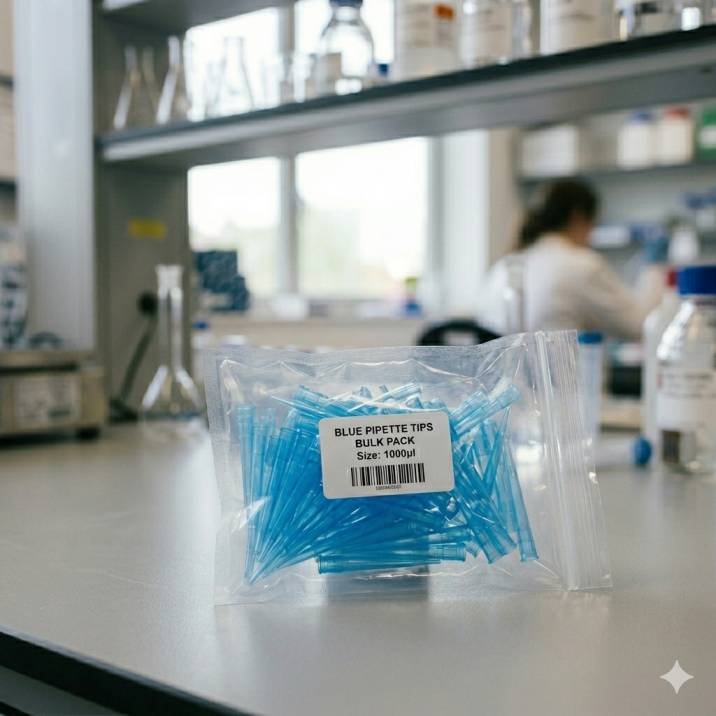
Description
Available Sizes and Capacities
Common Blue Tip Capacities
- 200 µL
- 300 µL
- 1000 µL
Packaging Options
- Bag packing
- Rack packing
- Sterile box packing
Applications and Usage
Research Laboratories
Used for accurate sample transfer in scientific experiments.
Diagnostic Laboratories
Supports clinical testing and laboratory analysis.
Pharmaceutical Industry
Used in formulation and laboratory testing procedures.
Chemical Laboratories
Suitable for precise reagent and solution handling.
Educational Laboratories
Used in biology and chemistry practical work.
Microbiology and Biotechnology
Supports sample preparation and analytical workflows.
Benefits of Using Blue Micropipette Tips
- Accurate and reliable liquid transfer
- Reduces contamination risk
- Compatible with standard micropipettes
- Disposable and hygienic laboratory consumable
- Smooth aspiration and dispensing
- Durable and leak-resistant design
- Suitable for research and diagnostic use
- Cost-effective laboratory accessory
Technical Specifications
| Specification | Details |
|---|---|
| Product Type | Blue Micropipette Tips |
| Material | Polypropylene (PP) |
| Capacity Range | 200 µL – 1000 µL |
| Color | Blue |
| Sterility | Sterile / Non-Sterile Options |
| Compatibility | Standard Micropipettes |
| Reusability | Disposable |
| Packaging | Bag / Rack / Box |
| Autoclavable | Yes |
Common Laboratory Uses
- Sample transfer
- Reagent dispensing
- Diagnostic testing
- PCR preparation
- Biochemical analysis
- Pharmaceutical testing
- Educational laboratory experiments
FAQ Section
What are blue micropipette tips used for?
They are used for accurate liquid handling and sample transfer in laboratories.
What material are micropipette tips made from?
Most laboratory pipette tips are made from polypropylene (PP).
Are blue pipette tips disposable?
Yes, they are primarily designed for single-use laboratory applications.
Can micropipette tips be sterilized?
Yes, many blue tips are autoclavable and available in sterile versions.
What sizes are available?
Common sizes include 200 µL, 300 µL, and 1000 µL capacities.
Are these tips compatible with all micropipettes?
They are compatible with many standard laboratory micropipettes.
Why are blue tips important in laboratories?
They help ensure accurate liquid transfer and minimize contamination risk.

Reviews
There are no reviews yet.