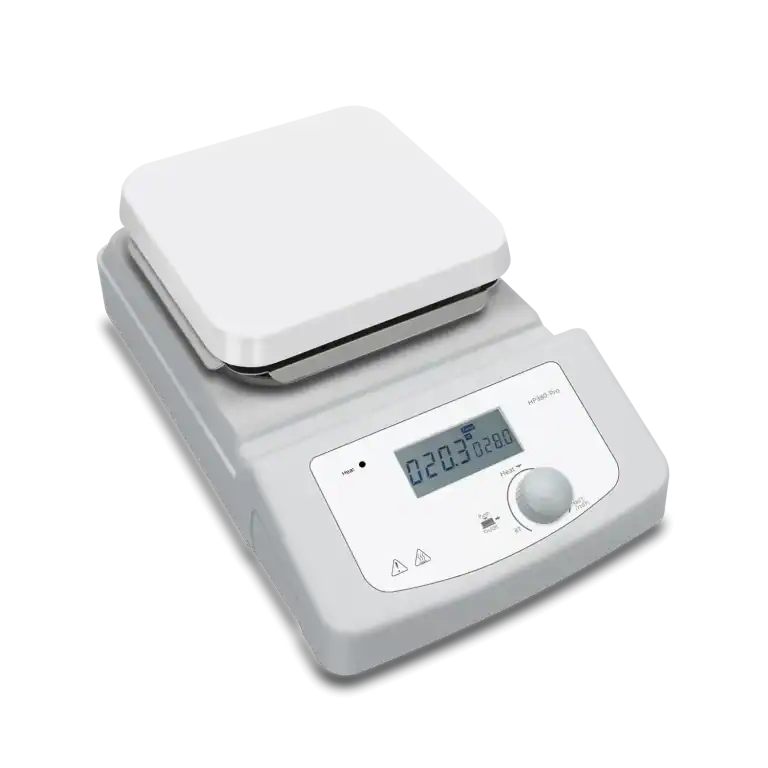
Description
Applications and Usage
Chemical Laboratories
Used for heating reagents, solutions, and chemical reactions.
Research Laboratories
Supports experimental heating processes in scientific studies.
Pharmaceutical Labs
Used in formulation, sample preparation, and testing procedures.
Educational Laboratories
Ideal for chemistry practical experiments in schools and universities.
Industrial Applications
Used in quality control and material testing processes.
Environmental Testing
Supports heating processes in water and soil analysis.
Benefits of Using a Laboratory Hot Plate
- Provides controlled and stable heating
- Improves laboratory efficiency and accuracy
- Reduces risk of open flame heating
- Suitable for a wide range of lab applications
- Durable and long-lasting performance
- Easy to operate and maintain
- Enhances experimental safety
- Supports precise sample preparation
Technical Specifications
| Specification | Details |
|---|---|
| Product Type | Laboratory Hot Plate |
| Heating Type | Electric Heating System |
| Temperature Range | Adjustable (Model Dependent) |
| Surface Material | Heat Resistant Metal/Ceramic |
| Control Type | Digital / Analog Control |
| Application | Laboratory Heating & Sample Preparation |
| Stirring Function | Optional Magnetic Stirrer |
| Power Supply | AC Electric |
| Usage | Laboratory & Industrial Use |
Why Laboratory Hot Plate is Important
A laboratory hot plate replaces traditional flame-based heating methods, offering safer, more controlled, and precise heating for scientific applications. It is widely used in modern laboratories where accuracy and safety are essential.
Common Laboratory Uses
- Heating chemical solutions
- Evaporation processes
- Sample digestion
- Reagent preparation
- Solubility testing
- Research experiments
- Educational demonstrations
Buyer Guide Before Purchasing Hot Plate
- Required temperature range
- Need for magnetic stirring
- Type of laboratory application
- Surface material preference (ceramic or metal)
- Safety features required
- Size of laboratory setup
- Budget and usage frequency
FAQ
What is a laboratory hot plate used for?
A laboratory hot plate is used for controlled heating of liquids, chemical reactions, and sample preparation in laboratory environments.
Can a hot plate be used instead of a Bunsen burner?
Yes, a hot plate is a safer alternative to open flame heating in laboratories.
Does a hot plate control temperature?
Yes, most laboratory hot plates come with adjustable temperature control systems.
What is a magnetic stirrer hot plate?
It is a hot plate combined with a magnetic stirring system that heats and mixes solutions simultaneously.
Is a laboratory hot plate safe to use?
Yes, it is designed with safety features like heat-resistant surfaces and overheat protection.
Where is a hot plate used?
It is used in chemical labs, research centers, pharmaceutical industries, and educational institutes.
What materials can be heated on a hot plate?
Liquids, chemical solutions, reagents, and laboratory samples can be safely heated.
Reviews
There are no reviews yet.